Showing posts with label evolution. Show all posts

Monday, July 30, 2012

The Market is Flawed

Evolution is a stochastic, self-organizing process. There is no invisible, guiding hand. It produces a lot of wonderful things. It doesn't produce perfection. It doesn't produce morality1.

The same is true of the market. I follows different rules, ad is based on a different system, but it's fundamentally similar. Organisms compete, some flourish and thrive, others whither and fail. Some get together and cooperate for mutual benefit.

It doesn't produce perfection. It doesn't produce morality.

Why is that so hard for some people to comprehend?

The free market allocates resources, money, and manpower to solve problems, and it does so with marvelous efficiency. However, it only solves profitable problems. It doesn't give a damn about anything that doesn't generate a profit. Caring about your fellow human beings doesn't generate a profit.

You only have to look at 90% of the examples for the last five hundred years for examples of appallingly selfish, inhuman behavior. Outsourcing jobs and shoveling the profits into foreign banks. DuPont lying about CFCs. Ethyl and Big Oil lying about lead. Tobacco lying about cancer and addiction. And that's all just within the last 60 years. In the nineteenth century, prior to the Roosevelts, they were even worse.

We have government for a reason, because self-organizing principles don't actually lead to the best possible outcome. It would be better for everyone if everyone had a good education and a decent job, but the market leads to inefficiencies and so some people don't have either of those things. The market honestly doesn't care; government steps in to take up the slack.

Is it a coincidence that the people who don't believe in evolution also fetishize the market's ability to solve all problems?

This is surprisingly appropriate. In a month, no one will understand why I chose it.


1 - Okay, actually it does. Problem is, it produces good and evil in equal measure as competing strategies.

Monday, May 21, 2012

Evolution Myths Part II

So I already covered a number of myths about evolution. Now I'll cover some more. They won't complete the entire list of erroneous things people believe, but maybe it'll flesh out our understanding both of evolution and of the weird crap people believe about it.

Of Course There Are Monkeys
The denialist loves to ask, "If we evolved from monkeys, why are there still monkeys?" Part of this is to deliberately set up the notion that evolution declares an equivalence between humans and monkeys to drive a wedge between the audience and evolution. However, this myth at its core misunderstands speciation.

Some species lives in a region A. It spreads, it grows in number, it explores the limits of its environment, then spills over into a second region B. Over time, geology happens and regions A and B are separated, isolating the two groups. Geology continues to happen, climate slowly changes, the environment changes. Perhaps region A becomes wetter and turns into a marshland while region B becomes more arid and turns into a grassy area with some stands of trees. The population of our species lives and adapts to each of these new climates. They mutate, they change. Their physical forms change and less obvious biological changes occur within. Eventually the two have changed enough that they can no longer interbreed. You now have two species where before you had one. At no point could you look at either and say, "Ah, this is clearly different to what came before." The change is always very slow, very gradual, and there will never be a clear dividing line.

Regions A and B don't even need to change for speciation1 to occur. Simple separation will be enough. Random changes will still accumulate in both groups and eventually genetic drift (also known as allelic drift) will build up to the point where the two groups will be chemically infertile. The geographical separation doesn't need to be drastic; it doesn't have to be something like a mountain chain springing up or an island separating from the mainland; simple distance will suffice. A ring species is one that has a long enough range that divergence has occurred between the individuals at either end. Subspecies A can interbreed with B, which can mate with C, which can make babies with D, which can totally start a family with E, but A and E are far enough apart that they're they're no longer interfertile. That's speciation in progress.

Another key item to note is that speciation doesn't mean that you start with species A and all of a sudden you have species B branching off of it. You begin with species A, then species A will split into subspecies B and subspecies C, still similar enough to interbreed but separated by geography2. They will continue to diverge until you have two separate species. They will still be obviously related, like the many species of cats alive today, and they'll also be clearly related to the ancestor species (with which they may or may not be able to interbreed; like ring species, but with time instead of space).

As for humans, we share a common ancestor with the two species of chimp, the common chimp and the bonobo. We share a more distant ancestor with the other great apes, the gorillas, and even more distant with the orangutan. None of those ancestors were the same species as any extant species.

The question above "why are there still monkeys" is like asking, "If you came from your grandparents, why are your grandparents still alive?", and what they're really asking is "If you came from your grandparents, why do you have cousins?"

Evolution Is Not a Tautology
Denialists like to claim that evolution doesn't contain any information. Natural selection chooses the fittest to survive, right? But how do we know which are the fittest? They're the ones who survive! It's circular! Like a donut!

Fitness has an actual definition. It's the relative propagation of a trait in a population. It's actually a mathematical definition. If the relative abundance of a trait increases from one generation to the next, then fitness is greater than one. If it decreases, it's less than one. For a single organism, it's defined as the relative contribution by the individual to the gene pool for that particular trait. Fitness is a multigenerational consideration and has to do not merely with how well an organism survives, but how it thrives and contributes to the survival and alteration of its species.

Evolution Does Not Predict Chimeras

Behold, the mighty crocoduck! That particular mythical creature is the favorite of Kirk Cameron, erstwhile child actor cum fundamentalist rabble-rouser. The denialist believes that speciation means mermaids and catdogs. That between species A and its successor species B, you'll find something that is literally half of species A stitched to species B. Evolution does NOT predict this. It definitely doesn't predict a transitional form that's two halves of modern species. This is a gross misunderstanding of the nature of transitional forms.

Look at red and yellow on the rainbow. In between you'll find orange. Zoom in some more and you'll find a color between red and orange. Zoom in further and you'll find another color, neither red nor orange, nor red-orange, but red-red-orange. Zoom in further and you'll find something that's redredorange-redorange in between the two. You'll never find a discrete line dividing any two colors. you'll also never find a color that's a bit of red stapled to a bit of orange.

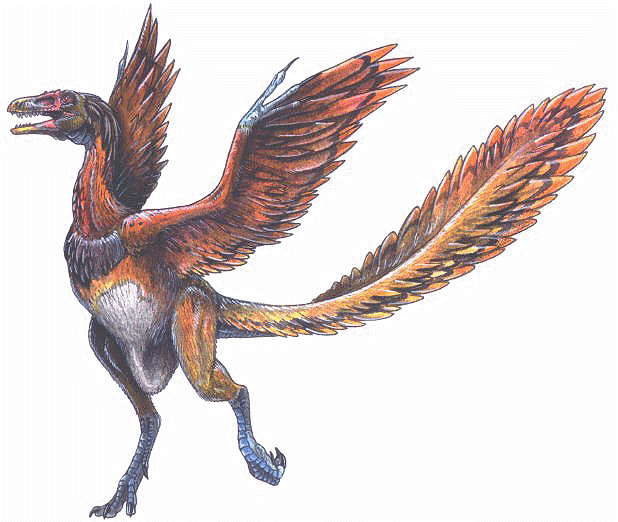
As it is with the colors, so it is with evolution. When A changes to B, it does so very slowly, very gradually. Tiny, incremental changes accumulate. A lizard gives birth to a dizard that gives birth to a bizard that gives birth to a bzard that gives birth to a bzrd that gives birth to a burd that gives birth to a bird, and it all takes millions of years. You never see something with the head of lizard and the tail of a bird. A transitional form is something like this:


That's an archaeopteryx. Discovered just two years after Darwin published On the Origin of Species it was a stunning confirmation of exactly what his theory called for: a transitional form between reptiles and birds. You can see that it has feathers, wings, and scaled hindlimbs like both bird and lizard. However, it still has a toothy snout like a reptile, along with a long, reptilian tail among those feathers. You can also see differentiated fingers on its fore-limbs, which aren't yet wings; birds will lose those fingers to create a fully functional wing. The archaeopteryx is an actual example of a transitional form. That's why evolutionary theory took the world by storm; it accounted for all the facts and made incredible and accurate predictions like this. That's what a theory does.

The chimera is not the prediction of evolution. It's the prediction of religion and myth, a magically created creature with no antecedents in the fossil record and no natural way of appearing.


Humans Are Still Evolving
The last myth I'll cover here, and one I haven't put on the TVTropes page yet, is that humans are somehow above evolution.

Lots of people, even people who are fully willing to accept that evolution occurs, that the earth is 4.5 billion years old, that the universe is 13.7 billion years old, and that humans actually aren't the be-all and end-all purpose of creation in a universe so vast that we don't even count as lint... they just don't accept that we're evolving. I believe it's related to the notion that we're rational animals (not really), smart enough to avoid stuff like that (we're really not), and that we've seized control of our destiny thanks to our intelligence (absolutely false. It is to laugh).

We're totally evolving. As I said last time, each of us is born with dozens of mutations. We can't know where we'll end up. Hopefully we'll end up without some of awful crap I mentioned last time. Who knows, maybe we're turning into this guy.


Well, that's it for now. There are tons of myths out there about evolution, but these have been some of the most popular. Maybe later I'll talk about global warming denialism.


1 - The term for the formation of a new species.

2 - Geography is too specific a term. I should be saying that their habitats become separated. If one group spends all its time on the ground and the other spends all its time in the tree tops, then they can still be isolated enough to speciate.

Friday, May 18, 2012

Evolution Myths

There are those who deny that evolution happens. Or they admit that it does happen, but only a little bit. Or, fine, it happens, but not to people. Or maybe it happened to people in the past, but we're too smart for that now. There are degrees of evolution denialism, just as there are degrees to religious fundamentalism. People who don't like evolution have their silly little beliefs; these are they, and why they're wrong.

Some of you may notice a lot of overlap between this page and the Useful Notes -- Evolution page over at TVTropes. That's because I wrote a significant chunk of that, and I make no bones about it. Other people have also contributed to it, not least they made it not look like ass. They also tidied up the verbiage and corrected quite a bit of my biology. Anyway, on to destroying some myths!


Evolution Has No Goal
Evolution is a stochastic (non-deterministic) process. It's not building toward anything in particular; hell, it's not building toward anything at all; hell, it's barely even building. Evolution moves around randomly, sampling the landscape of potential forms and behaviors. It fills every niche. In so doing, it creates new niches, then it fills them, creating new niches to fill! Leave it to a nineteenth century poet to say it:

Great fleas have little fleas upon their backs to bite ’em,
And little fleas have lesser fleas, and so ad infinitum.
And the great fleas themselves, in turn, have greater fleas to go on;
While these again have greater still, and greater still, and so on.

De Morgan: A Budget of Paradoxes, p. 3771

Evolution is sort of like a gas; it expands to fill the space it's in. But it's also simultaneously creating that space. It's a weird, squirmy, umpty-dimensional gas. Wibbly-wobbly, timey-wimey. But it doesn't have a goal. It doesn't pick winners.

The most tragic consequence of this myth is what it did with the notion of the superior race, which was around long before Darwin developed his theory. The Nazis were the most famous purveyors of this myth, but it was widespread among many groups in many nations until the Nazis demonstrated how utterly horrific it is when taken to its natural conclusion. This myth, and its natural end, are both used by opponents of evolution as an argument against it, but evolution doesn't predict this.

A human, a tree, a sea slug, and an E. Coli bacterium are all highly evolved organisms, flourishing in their environments and striving to pass on their genes. None is superior to the others, none more highly evolved. A cheetah is particularly well adapted to running down fast prey, but it will never outfight a bear, which will never be as deft with its paws as a raccoon, who can't swim with the fishes, who don't know how to do math. We are each of us what we are, with nearly the same 3.5 billion years of evolutionary history behind us. And a tree won't have nukes, anger and lower back problems2.

Evolution: More than Mere Chance
Evolution is an unguided, stochastic process with randomness at its heart, but randomness isn't the only thing their is. Natural selection is an incredibly powerful tool that immediately weeds out negative changes and strongly favors positive.

Imagine 1000 people flipping coins. If they flip every five seconds, how long before they come up all heads? On average, 1,697,702,940,000,000,000,000,000,000,000,000,000,000,000,000,000,000,000,000,000,000,000,000,000,000,000,000,000,000,000,000,000,000,000,000,000,000,000,000,000,000,000,000,000,000,000,000,000,000,000,000,000,000,000,000,000,000,000,000,000,000,000,000,000,000,000,000,000,000,000,000,000,000,000,000,000,000,000,000,000,000,000,000,000,000,000,000,000,000,000,000,000,000,000,000,000,000,000 years. That's 10^284 times longer than the universe has been around.

Now, imagine that they all flip and keep the heads. Everyone with tails flips again, and they keep the heads. Anyone who has tails flips a third time, and so one. How long before we have all heads? 500 + 250 + 125 + 62 + 32 + 15 + 8 + 4 + 2 + 1 + 1 = 1000 heads in 11 flips, on average, for a total of 55 seconds. Flipping randomly hoping to get a particular outcome is unrealistic, but once you throw in the power of selection, you take away the sting.

Whether life on our planet is as dramatic as my coin toss example depends on the power of your imagination.

Evolution Promises Very Little
Evolution doesn't promise us the best of all possible worlds. It promises us the bare minimum to get where we are right now. That's why we have lower back problems. And wisdom teeth that get impacted. And a tiny piece of intestine that likes to crawl up its own ass and die. And then there's the pregnancy thing. And the pelvis thing. And our knees. And we're blind and deaf. And our children are completely fucking helpless for about a decade and a half. And have I mentioned that we can't run very fast? And we're no good in the cold. Or the hot. Or the water. And man alive the desert will kill us so fast.

And that's just what's wrong with human beings. Evolution isn't magic. It'll find solutions for all of our problems, but it'll take a few thousand generations, and it'll find new problems along the way.

Evolution is About How Life Changes
It isn't how life began. The origin of life is called abiogenesis. ('a' - not, 'bio' - life, 'genesis' beginning. 'abiogenesis' - how life came from non-life). Evolution is about how life, once it's here, has developed and changed. Descent with modification and natural selection is the theory that explains the observed process of change in life already extant.

Abiogenesis is a hella interesting field that lies in the borderland between geology, chemistry, and biology. So far we know that it took at most about half a billion years for life to appear on Earth, however it formed, because we have fossils of bacteria nearly four billion years old. We can know something about the conditions, and geology and chemistry and physics are all working together to piece together those conditions and give us a clearer picture. Then biochem steps in and works out how you get from those to how life can appear. It's a wonderfully fascinating endeavor.

But it's not evolution.

I'll be honest; we might not ever know exactly how life evolved on Earth. If we're phenomenally lucky, then perhaps we'll get to observe it happening on another planet, or maybe we'll make incredible breakthroughs in theoretical chemistry and physics and develop a fantastic model of the early Earth. I don't know; ignorance actually is an acceptable position to take in science. "I don't know" is always the starting position, and a possible finish line. It's never a satisfying position, but it's acceptable in the face of little or no evidence.

But abiogenesis and the current state of that field of study have no bearing on evolution. Evolution is so well established that trying to overturn it is like trying to overturn gravity. When I say we have tons of evidence for it, I mean literal tons. We're talking about actual rocks here.


We'll cover more myths in part II.


1 - The line originally appeared in a poem by Jonathan Swift, who was mocking the idea of self-similarity in fractals. What I quoted is from a mathemetician later in the century who was also discussing fractal self-similarity. But it works.

2 - Those three lines I lifted right from the TVTropes page. I wrote the original, but it's been edited since, and I have to give props to user memememememe for fleshing it out.

Monday, May 14, 2012

What is Evolution?

Me, I love to learn. Back before I used RSS feeds, I checked my daily funnies* by hand; first clicking individual bookmarks, then wheel-clicking folders to open them ALL AT ONCE. Glory! Anyway, when I was gifted with wheel-clicking by Firefox, I added five random wikipedia pages to my funnies list. It was pretty neat. There are a lot of small European villages with their own wikipedia articles**. Nowadays I have the RSS feed, so I get tons of articles from atheist blogs, skeptical blogs, feminist blogs, science blogs, and my daily funnies. So I'm reading less wikipedia, getting more informed about some niche advocacy groups, stretching my brain a bit to accommodate unfamiliar science (there are more biologist bloggers than physicist bloggers, I find), and getting my daily chuckles.

So why not post a brief intro on evolution? Even intelligent, well-educated people are ignorant about a lot of things. Why, I have friends who pay for homeopathic "medicine"! And they went to college!


But that's another post.

Essentially, evolution boils down to two principles. Descent with modification and natural selection.

Descent with Modification
You are like your parents, but not exactly like your parents, and a similar observation is true of all living things***. This isn't just that your DNA is a mix-and-match of your parents', but also that each offspring contains multiple mutations. When the DNA gets read and copied, the copy contains errors. For example, each human receives somewhere between 60-120 mutations. Given that there are billions of base pairs in the human genome, that's remarkably high fidelity.

Not all mutations are negative (a common fundamentalist myth). To be sure, many are; any living organism is a highly evolved machine, and a mutation can really throw a monkey in the wrench. However, mutations can also be beneficial. For example, roughly 10% of people of European descent have a copy of a gene that renders them resistant to AIDS. Having two copies makes you resistant to infection by HIV in the first place, while having only one slows its development into full-blown AIDS.

That said, the vast majority of mutations are neutral. As I said, we're all walking around with dozens of mutations, but we're mostly not obviously supermen and also not casting as extras in post-apocalypse films. Nevertheless, mutation is vital, because without it, there would be no change, no differences from one generation to the next, nor between individuals, and without differences, there would be no...

Natural Selection
This isn't really "survival of the fittest", popular though that phrase is, but that's a part of it. In the end, evolution is about reproduction. Really, it's about having grandchildren. Who have grandchildren. Who have grandchildren. Fitness has a mathematical definition: the proportion of individuals displaying a trait after selection compared to the proportion before. In this case, "selection" means the process whereby the group decides who has offspring and who doesn't. Mating season for bears, say, or the prom for drunk teenagers.

Notice that the item in question isn't an individual organism, but a specific trait of that organism. What precisely is being selected has been a source of contention in biology for some time now. Richard Dawkins was long a proponent of the idea that the gene is the natural unit of selection; see his book The Selfish Gene. Others have argued, with merit, that the unit of selection is the genotype, the phenotype, the organism, populations of organisms, or even entire species. Not only do all these arguments have merit, I suspect that all are true, to a degree.

An individual gene can be particularly beneficial or particularly harmful in itself, and be selected for or against. No gene acts in isolation, though; rather they act as cartels, cooperating to build the organism and its parts, and those cartels can be selected for or against. And those cartels can only be considered in the context of the genotype of which they are a constituent, and its ability to build and maintain an organism. And that genotype isn't immune to how it interacts with the environment to produce a phenotype; a genotype that thrives in one environment may produce a different, and indeed inferior, phenotype eleswhere. Once the organism has been constructed, it is then tested and selected in its environment, first as an individual, then as a member of its particular group, which is then considered as a component of an ecosystem, and then the species as a whole is tested against all the systems they've managed to penetrate. I can't imagine that any of these can be neglected (though the timescale under consideration surely favors some over others), and I expect they all inform one another to remarkable degrees.

There is such a thing as selection against a trait. You don't have children? You're a failure.**** You have children? Good for you! But if they don't have children, you're a failure. You have grandchildren? Good for you! But... All individuals die, all species go extinct, but their DNA can go on as they mutate and evolve into something new, something fit, something beautiful, however temporary. The dinosaurs, for example are all gone, but not entirely.

There is also a way to select for, rather than against. A truly exceptional individual can see to it that his genes propagate quite well into the next generation, and the generation beyond. Like I said, there's a measure of fitness, and a fitness score of greater than one means you're really spreading your seed. However, whatever trait(s) makes an individual fit is always temporary and provisional, because it's fitness as proved against a certain environment. Also, once the trait is spread through the entire population, the best you can hope for is a fitness score of 1. Still, there is always that burst of glory.

So there it is. My understanding of evolution. Next time I'll talk about some of the common myths (a few were mentioned), and why they're wrong.


* You know, funnies, comics. The things that, in newspapers, are three panels of minimalist drawings coupled with mediocre humor and that, online, are freed from all constraint and delve into varying styles of artwork that ranges from acceptable to gorgeous and humor that covers the gamut from chuckles to guffaws and stories anywhere from slice-of-life to wild speculative fiction. In other words, awesome symphonic taste sensations as opposed to the bland, de-flavored, luke-warm sugar free tapioca you get in the paper.

** Essentially, "BLANK is a village in the BLANK province of BLANK. It has a population of BLANK. They fucking LOVE football."

*** Evolution is more complex for bacteria, which can exchange genetic information, forming less a tree of life and more a web of life, but let's not confuse the issue.

**** No you're not. Among other things, because it's not just about you, it's also about your genes, your family, and your species. So long as any of those survive and thrive, thanks to your actions, then you're not a failure; you're a success. Also, thanks to writing and whatnot, it's not merely our genes that can survive our deaths, but the knowledge and works we've created. Nature invented immortality when it discovered life; we've invented another kind.

Wednesday, November 09, 2011

Evolving Beyond Religion

The Bible says, "Thou Shalt Not Kill".

Actually, it's "Thou Shalt Not Murder". And the act of murder can only be committed on human beings. And that really only applies to your fellow X. Heathens are fair game.

That was the interpretation for thousands of years. The law said that if you threw a stone into a crowd of heathens and accidentally killed one of your fellow faithful, then it wasn't murder because your clear intent was to kill a heathen.

In ancient pre-history, we lived in small family groups of a few dozen to a few hundred. As our populations grew, we encountered, who knows how many times, the Stranger Problem; how can you live with the constant fear of the stranger without killing him? In order for civilization to exist, this problem had to be overcome. The earliest forms were probably the discovery of distant kinship, as small groups living near each other probably had tenuous blood connections due to the outbreeding necessary to prevent serious genetic difficulties. Also available, particularly at trading confluences, was honorary kinship, the sacred guest rights. But those are cumbersome and were replaced by religion, by civilization, eventually by nationality, and in due time the rule of law. In some places.

Why is it that in times past, the most horrific acts of cruel barbarity were commonplace wherever two people got together to kill a third? And why is it that in much of the world, these acts are becoming much more rare? Indeed, why is it that a mere five thousand years after the Bible began being written, a modern reader can look at it in astonished horror that these things were considered just and moral?

Because we're still evolving. For a few million years, we evolved to live in small family bands, and it shows. I used to scoff at the notion that small towns were just nicer and safer and all that, thinking it was provincialism at its worst*. It turns out that small towns are safer, nicer, more polite. And that's because everyone knows one another. First, there's social pressure to be nice; when word gets around (and it *will*) your life becomes that much harder if you're a jerk. Of course, the sword swings both ways, the social pressure requires you to conform in all things, not merely in social niceties; Garrison Keillor, of A Prairie Home Companion once said that moving to New York from his small home town was a huge relief because he could finally relax and just be himself away from prying eyes. Another aspect of city vs town life is the presence of strangers; being surrounded by strangers raises your stress levels, making you more unhappy and quicker to anger. Whereas the townsman is open and friendly, the city dweller maintains a personal shield of privacy, ignoring others as much as possible. City dweller, when's the last time you started a conversation with the person sitting next to you on the bus/subway?

Strangers used to represent an entirely potent threat; a stranger was someone who, at the least, might kill you and take all your stuff just because. After a few thousand years, that reflexive fear hasn't gone away.

But I suspect it's starting to, because I don't believe we could have spent 500 generations living with the constant presence of strangers in cities of tens of thousands, and now tens of millions of people without weeding out those people who simply could not abide strangers, without selecting for people who are more tolerant of strangers, more willing to live and let live. Where once it took a great deal of effort to live with strangers, where it was once the case that civilization only managed to independently arise in a very few places, where once we had to invent an omnipresent and angry skybeard to keep us from murdering one another, we can now walk down the street in relative safety.

The world is by no means a perfectly safe place, but it is not what once it was. We have spent thousands of years and hundreds of generations learning, in our bones, how to cope with a civilized world. The changing and advancing of the zeitgeist such that slavery has vanished and racism is waning could be explained by happenstance, by random cultural shift, or it could be that evolution is shifting us away from the paranoid, family-bound apes that we were into an open, embracing humanity ready to live in a global society.

I believe that we developed religion as a desperate necessity to allow us to build our cities, and I look forward to the day when we realize that, like xenophobia, it is a tool that was once useful but which is no longer necessary.


* In the sense that where I live is awesome and everywhere else sucks, not in the sense of a naive misunderstanding of the way the world works.

Monday, November 07, 2011

Evolution on Good and Evil Part 3

Now for evil. I think we have to distinguish between banal evil and true villainy.

The Banality of Evil was a phrase coined for a report on how the Nazis could attempt to exterminate any number of groups without being a group composed entirely of monsters. As Terry Pratchett put it, "There are hardly any excesses of the most crazed psychopath that cannot easily be duplicated by a normal kindly family man who just comes in to work every day and has a job to do."

This sort of evil comes from the third pillar of morality. People on the outside don't count. You don't betray family or friends, you don't steal from them, or kill them. People on the outside just. Don't. Count. Granted, you have to go out of your way to dehumanize them and demonize them before you're willing to do really horrible things to them (a dozen or so centuries of hearing "perfidious Jew" as part of the Catholic liturgy every year probably helped the Nazis demonize their victims; perfidious originally meant unbelieving but somehow, impossibly, it came to mean "treacherous").

The other sort of evil is that sensationalized by Jack the Ripper and Hannibal Lecter. In somewhere near 5% of the population at large are people with no empathy and no remorse. The terms are confused between psychopath, sociopath, and antisocial personality disorder. Generally, these people have poor impulse control and no empathy for others. Whereas the moral impulse in the majority of people is governed by two parts of the brain, one utilitarian (sure, kill one guy and distribute his organs to save five) and one empathetic (kill a person to save five? You monster!), the psychopath lacks the empathetic response. They don't always become serial killers and monsters, but the majority of violent offenders in prison show signs of sociopathy.

Whence the sociopath? Whereas morality is a system whereby evolution has gamed for cooperation for mutual benefit, sociopathy is a system that parasitically takes advantage of the first. Too many sociopaths and society couldn't possibly exist. Too many backstabbing bastards and there would be no potential benefit to backstabbing. Only if sociopaths are a minority can they succeed. When 95 times out of 100 you can trust your buddy to do right by you, the backstabbing bastard can really make a killing.

This isn't an unsuccessful strategy, no matter that we like to believe people get their comeuppance. A bastard-coated bastard with a creamy bastard filling can really get ahead, particularly in a more populace society where strangers are common. A questionnaire filled out by CEOs with questions hidden within to indicate sociopathy indicated it's more common (perhaps twice as much as in the general population). It's not hard to imagine that being a ruthless jerk could make you successful on Wall Street, legally or not (see: Enron).

In the end, whether dealing with the banal evil or dispassionate sociopathy, evolution easily explains evil. As the existence of the theodicy problem demonstrates, the god hypothesis really doesn't.

Evolution On Good and Evil Part 2

As I've said before, I'll continue to discuss the biological basis of morality.

To reiterate, these are the five pillars of human morality elucidated by Dr Jonathan Haidt:

1) Fairness/Equity
2) Injury/Harm
3) In-Group Loyalty
4) Respect for Authority/Elders
5) Sanctity/Purity

As I said, the first two form the basis for reciprocal altruism. The third reinforces that by forming an us vs them mentality; those on the inside are fully human (or chimp, for our chimp cousins), those on the outside are not. We can see this among ourselves today and in history. Our close family is incredibly important, our more distant family/friends come next, and so on, until we come to strangers who are also foreigners of a different religion who dress funny who barely qualify as human. Yes, that's an increasingly outdated concept, but it's still out there.

How does identifying someone as not being worthy of altruism reinforce altruism? Because we can't be indiscriminate. Resources are scarce and we can't share all the time with everyone. Identifying some people as more important than others helps decide who we share our limited resources with, who we fight for and who we abandon. From the standpoint of the gene, we need to defend those closely related to us and help them because they share our genes. From the game theory point of view, cooperation, whether among kin or strangers, leads to a greater degree of success.

The fourth I believe started as respect for authority, a way to sort the group into a less egalitarian family band, with certain individuals in charge and others following. Think on this, the origin of the "moot point". "Moot" is an old English word, originally meaning, essentially, "a democratic assembly to discuss important points", hearkening to the democracies that were Germanic English villages. Important things had to be discussed before the moot (you may recall the term showing up in the _Lord of the Rings_ trilogy, as Treebeard [AKA Fangorn] called for the Ent-Moot), thus a 'moot point' was something too important for one person to decide. However, the nature of democratic assemblages is that the larger the population, the more untenable direct democracy becomes, and thus the moot got sidelined in favor of more autocratic processes and a 'moot point' gradually became something so unimportant that it could be put before the moot without any harm. To put it another way, "A committee is the only animal with twenty stomachs and no brain".

When one person is in charge, things get done (not necessarily for the best, see my explanation, forthcoming, for why democratic-republics are the most awesome form of government). Although our ancestors were apparently largely egalitarian while living in small family groups (according to anthropology), they segued into pseudo-chiefdoms, followed by chiefdoms, followed by increasingly stratified, rigidly defined hierarchical religious kingdoms. Respect for authority started as a way to organize small, flexible group relationships and was reinforced as a method for organizing large, inflexible group relationships.

However, I believe that number four became, for humans at least, respect for elders as a method of education. We're not the only animal that teaches their young, but we may be unique in that we educate through language. Our young are credulous to a fault and respect for elders reinforces that. It's not just among children, though; think about the last time you were the new guy in the workplace. How respectfully did you listen to the guy who showed you around? How long did it take for you to stop being the new guy? And when the next new guy came in, how easy was it to assume an air of authority as the guy who knows what's up? It works.

In short, I feel that these first four pillars of human morality shape our interactions among a group, for short- and long-term benefit through mutual cooperation and reciprocal altruism.

What of sanctity/purity? That's the notion that the body can be harmed/made impure through immoral behavior, which notion isn't restricted to religion (vegans, anyone?). I believe it started as a simple biological compulsion to avoid eating things like poop that was repurposed. Our hierarchical/authoritarian bent was repurposed by our need to educate our offspring, and I think our disgust imperative was repurposed for a social function. I'll get into that more later.

For now, I think I've discussed where our moral sense comes from enough to provide a good argument that, although the god hypothesis does not explain either good or evil, evolution certainly explains good as the result of game theory and gene theory.

Tuesday, October 04, 2011

Evolution on Good and Evil

I've stated previously that I'm a moral relativist, a nihilist, et cetera. I believe that human morality stems not from some absolute command nor from god but from our biology.

Recall the Prisoner's Dilemma. At first glance it appears that there's no reason for the prisoner's not to inform on one another until you add the notion of history, memory. Once reputation appears as a reason not to squeal, the dilemma disappears and human behavior goes from inexplicably illogical to mathematically sound. This suggests that natural selection is a mathematician into game theory.

There have been competitions by computer programs playing the Prisoner's Dilemma over and over. Multiple times against each of multiple opponents. The winners have always been nice (don't start with betrayal), retaliatory (willing to pay evil unto evil), forgiving, and not envious (not trying to outscore the opponent). In other words, a moral being.

But then something else happened. People were allowed to enter multiple programs. They did so with multiple programs designed to take a dive and a designated winner; they recognized one another with a complex handshake. The result? The designated winner won. Not only is cooperation favored by game theory for one on one interactions, so are complex cartels. This result shouldn't be surprising, each and every human being is not merely an agent, but a complex cartel. We are each of us the result of billions of living individuals cooperating for mutual benefit. Each of us is, quite literally, a corporation*.

It's not just humans and other animals that cooperate. Even single-celled organisms cooperate. At least one species of unicellular heterotrophs come together in cooperation (using the same gene that allows the cells of multicellular organisms to recognize one another and cooperate) in a fashion that makes eating and locomotion easier.

Morality isn't just cooperation though, is it? It's about not killing people or robbery or rape, et cetera. The work of Dr. Jonathan Haidt has elucidated certain universal moral truths that all humans hold in common.

1. Fairness/Equity
2. Injury/Harm
3. In-Group Loyalty
4. Respect for Authority/Respect for Elders
5. Sanctity/Purity

The first two obviously function as aids to cooperation. Interpersonal interactions mediated by these two moral rules foster cooperation by requiring first that each partner receive, not equal, but commensurate gains from cooperation. Further, a prohibition against injury that prevents simple physical betrayal. Individuals living together will come into conflict and that prohibition means that, even when things go bad, they can continue to function as a group. In fact, the first two, with the addition of the third, comprise the basic set that define success for the iterated Prisoner's Dilemma.

But why is that necessary? Compare us to our closest cousins, our fellow apes. Our distant cousin, the orangutan, is non-tribal. Males live in non-overlapping territories and females live in non-overlapping territories, while the territory of a male overlaps with those of several females. A closer cousin, the gorilla, lives in troops, generally with only one adult male, but occasionally multiple.

Closer still, the chimpanzees, which live in tribes with multiple males and females, often quite cooperative. The common chimp is more aggressive (males from one tribe are hostile to strange males and even band together to hunt them down) whereas bonobos are more peaceful. Both groups are highly sexual, using sex to "make love, not war" even pansexual**. Generally, their behavior shows a cooperative nature similar to our own. They're fair, they avoid injury... and they're loyal to those of their own tribe, sometimes at the expense of those from others.

The upshot of this is first that our closest cousins have a social structure that mirrors our own, thus necessitating the same moral rules that we have; and not just the first three. The common chimp has a strict hierarchy with male A in charge, then male B, then C... Bonobos are less hierarchical, but are matriarchal and 'less' doesn't mean 'not at all'.

Further, the apes aren't the only animals with hierarchies. Horses are likewise hierarchical, following the lead of a head mare and head stallion. Even small birds have hierarchies. Chickadees take the risk of sitting high in a tree and looking for threats. Their name comes from their characteristic cry of "chick - a - dee dee dee" when they see a threat. The more "dee"s, the greater the threat. They vie for this position, with birds of higher social position acquiring, literally, higher positions as look-outs. Other small birds determine and acquire social status through aggressive altruism; giving gifts is a sign of, as it were, virility and a sign that the giver is so awesome he can afford to give away food.

This is another argument in favor of evolution loving altruism; not merely as a means of maintaining genetic code by helping a relative, but also as a means of reinforcing hierarchy.

I will continue my discussion of moral pillars 3, 4, and 5 in my next post.


* From Latin, for "physical make up".
** Get it? The genus Pan? I am so clever.